Greenland To -65.3C (-85.5F); Historic Blizzard Buries The Northeast; 2025 Had The Lowest Global Wildfire Emissions On Record; + CO2 Is Not A Pollutant
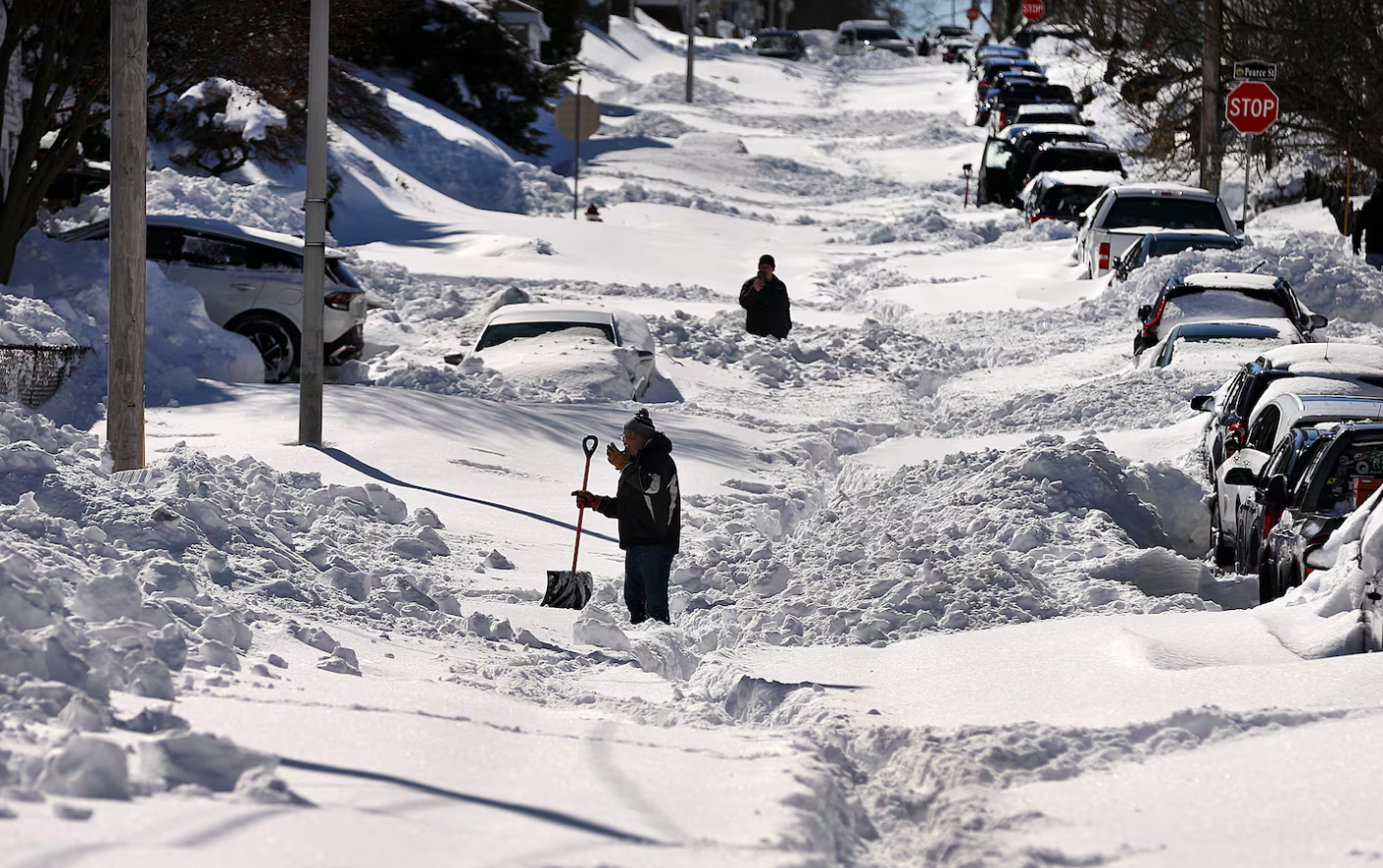
The Boston Globe —a daily promoter of global-warming alarmism— failed to print for the first time in its 153-year history, shut down by the historic cold, snow, and ice.
 Unlock with Patreon

Calling CO2 poison marks the entrance into the dark ages, despite our technological advancement. Dire indeed.
I am a degreed botanist so I am fully agree that CO2 is NOT a pollutant. It is in fact essential for life on this planet. Without it we die. Actually if CO2 in our atmosphere drops to less than 200 parts per million, we all die. It is as simple as that. Simplistically CO2 plus water is converted into oxygen and sugars via photosynthesis. Without photosynthesis oxygen disappears fairly rapidly. The Green New Deal efforts to eliminate CO2 is essentially trying to kill us all. We need much more CO2 in our atmosphere than currently exists, not less. More CO2, means more and better food along with more oxygen. The greening of the deserts is just one of the many surprising (to most) benefits. Love CO2!
Hi Allen.
The lowest historical atmospheric CO2 levels have been recorded at 182 ppm, which occurred at the end of the last glacial advance.
( source: my putor and Dr. Patrick Moore )
I would change the above statement from recorded to assessed as some suggest CO2 can escape from ice core samples.
It is commonly stated that an atmospheric level of CO2 at 150 PPM is where broad plant suffocation occurs.
Any comments?
I do not want to test either the 150ppm or the 200ppm level. I suspect we’d all be suffering long before CO2 levels dropped that low.
Three consecutive days without a sunspot. Quite a reversal.
Does Professor Valentina Zharkova know something that Spinkly does not?
I see you’ve been using the sensible side of your brain lately. You’ll get tired of that, and when you do, I’ll be waiting…
Enjoying my longer days.
Waiste of good daylight time. Mumble mumble, grumble grumble.,
Bite yourself, Muffin!
Well, darnit! There goes my New Year’s resolution!.😝
It may be that LIAs begin, in part, with a more rapid reduction in solar energy than what normally occurs on the back side of a solar cycle.
Perhaps some component of the good professor’s double dynamo theory indicates such a reduction.
Don’t you guys ever get tired of saying perhaps, maybe, it could be? I know I get tired of hearing it, especially after 20+ years. Either it is or it isn’t, for Pete’s sake and I would say the same thing to Valentina, given the opportunity!
A well regarded maxim is;
‘It is difficult to make predictions, especially about the future.’
Sounds like something Charlie Chan would say. Except it would sound more intelligent coming from him.
The saying is attributed to Niels Bohr: A Pioneer in Quantum Mechanics.
Niels Bohr’s work in the early 20th century was pivotal in the development of modern quantum mechanics. His Bohr model of the atom proposed that electrons orbit a positively charged nucleus in stable orbits, with energy levels that are discrete and can jump between them. This model was a significant step forward in understanding atomic structure and quantum theory.
Bohr’s Copenhagen Interpretation of quantum mechanics, which he co-authored with his colleagues, provided a new framework for understanding the behavior of particles and the nature of the universe. His work not only advanced atomic physics but also contributed to the broader field of quantum mechanics, which remains a cornerstone of modern physics. Bohr’s legacy endures through his influential theories and his role in educating future physicists, marking him as one of the key figures in the history of science.
Yogi Berra said it slightly differently: “It’s dangerous to make predictions, especially about the future.”
Right on Jay.
It doesn’t take much to get out of my orbit, Moffin. Guys like Einstein, Bohr, Hawking are way far above 🙂
And yet he could say something that stupid. Maybe he was an idiot savant. Come to think of it…
Niels Bohr..
Oh, I was just thinking out loud. I’ll try to think in someone else’s direction.
Fit her with an electric dog collar and hit the button for half a second first thing each day.
First, you have to get the collar on her…